
DHURANDHAR THE REVENGE
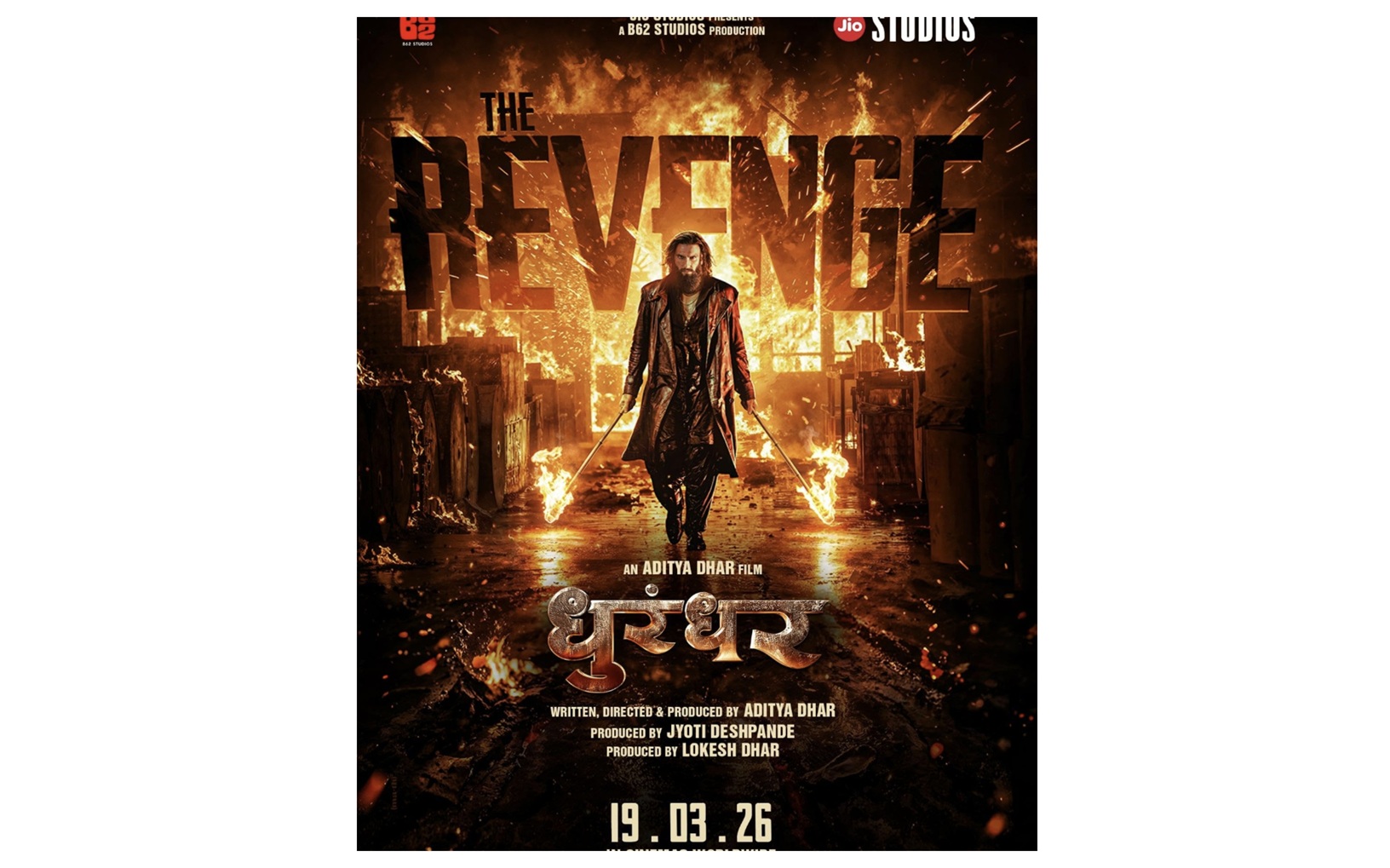
DHURANDHAR THE REVENGE : MOVIE REVIEW
RATING : 2.5 STARS / 5 (ABOVE AVERAGE)
WRITER DIRECTOR PRODUCER : ADITYA DHAR
CAST : RANVEER SINGH, SARA ARJUN, MADHAVAN
ARJUN RAMPAL, SANJAY DUTT, RAKESH BEDI
HINDI (ENGLISH SUBTITLES AVAILABLE), 2026
"Good" News : In more than 15 years of my movie watching in New Zealand's theatres, Dhurandhar The Revenge is the first and only film to have an intermission - a 10 minute break in the middle of its gargantuan four hours, during which the audience gratefully shuffled out to empty their bladders without missing a part of the movie. Bad News : The same unnecessary, sometimes boring runtime of nearly two hundred and forty minutes is long enough for Aditya Dhar's grandchildren to come along so that he can show them how guns are indiscriminately fired and skulls are bashed to pulp in a mad frenzy of revenge. Pic, ambitiously produced, imaginatively written, competently directed and recklessly lengthened by Dhar, has capitalized on the violent, cunningly populist Part 1, to more or less play the same pulpy, gory game to absolutely rock the worldwide box office for an Indian movie. Rs.236 crore ($25 million) has been racked up right on day one, earning in one day what high-grossing Indian movies earn in their entire lifetimes.
Ranveer Singh has been the one competitor to Ranbir Kapoor in the last fifteen years and he terrifically shoulders the raw scud missile of this bloodthirsty ride from start to finish with his silent boiling intensity. His Hamza, an Indian spy who craftily rises in the Karachi underworld in Part 1, is now ordered to finish off the nexus of gangsters and politicos who keep plotting terror attacks against India. While revenge is indeed a dish best served back at the right time and temperature, especially against terrorist networks who keep targeting your country, there is an unsettling pleasure that this film takes in the barbaric killings and gratuitous torture that undercuts the mission of a patriotic spy thriller. The selection of Pakistani gangsters and politicos in power who make all the nefarious plans are reduced to caricatures - admittedly they are not Lee Kuan Yews or Einsteins but the cardboard cut-out characters reduce the intelligence of the movie. Fights, be it hand-to-hand or explosions or special effects, are ordinary - losing an opportunity for excellence in this genre of action thriller.
Story kicks off with the hellish origin story of Hamza (Ranveer Singh). India's RAW (Research & Analysis Wing) trains and implants him in Lyari, the gangster-infected politically contagious locality of Karachi, and he rises through the echelons cunningly pitting goon against goon till there is only a puddle of gore which he walks through enroute regally ensconcing himself on the throne of Lyari. From here on, his mission is to go on an exterminatory spree, wiping out the entire wicked web from corrupt cop right up to the intelligence service honcho. Dawood Ibrahim recoiling but still hissing from some fancy pit in Karachi, Rs.60,000 crore of fake currency waiting to poison India's finance veins, a K2 mountain of addictive drugs waiting to devastate Punjab ? No problems - Hamza will take care of it and then some.
Ranveer's Hamza is the one constant bulwark throughout the movie - the fatalistic ferocity knifed into his rugged handsomeness as he calmly plots one retaliation after another through his steely light-hued eyes, muscled chest and arms, flowing flamboyance of shoulder length hair. The primacy of this character's purpose is matched by two others - the suited, tied, slightly balding, lightly nerdy-looking, bureaucratic modern-India Chanakya that is Ajay Sanyal (an excellently restrained Madhavan), the head of the intelligence unit who coolly plots his chess moves despite the blood and cataclysms, and sometimes smokes a cigarette just in case someone still thinks him a geek.
The other alpha persona is Major Iqbal played with icy blunt venom by Arjun Rampal. Major Iqbal is the top marauder in this story, using his high execution position to catch and crush counter-espionage while constantly concocting and sending Satanic influences across the border, a honcho for Pakistan's ISI - an organization that deserves a Nobel prize for rigorously maintaining the lofty goal of painfully dissecting India year after year. Major Rascal Iqbal is outrageously trolled by his fantastically foul-mouthed frail "father" Brigadier Jahangir (Indian college students looking to learn ragging / hazing will pick up useful lines here) who flays his hapless son alive with the dirtiest volleys of withering vulgarities. Nice Freudian taunts push the son further and further... This is one of the movie's more darkly savoury subplots. Alas, further psychological profiling is absent in Iqbal's character who shouts anti-India slogans till the end and remains a two-dimensional baddie, whereas Rampal with his debonair flourish and understated range could have taken on a more complex character had Dhar taken the trouble to tailor one for him.
Real life parallels abound, giving the film an immediacy - the proposed reasons behind India's notoriously famous "demonetization" episode in 2016 where high-denomination cash notes were outlawed, the addictive-drug "pandemic" in Punjab, politically powerful Uttar Pradesh state's abbatoirs opening their veins not only for blood letting but also for infusion of fake currency into national arteries, and India's real-life prime minister Narendra Modi making multiple appearances in a film that his base would particularly root for.
DTR has enough chapters to fill the runtime no doubt but then Mario Puzo's magnificent novel "The Godfather" also had enough material to fill more than twenty hours of gorgeous movie-making, but Coppola did not fall for it (he fell a lifetime after both parts were concluded). Pic could have clocked 3 hours just fine instead of adding one lugubrious hour of watch-watching in shafts of theatre light. To be fair to Dhar, he constantly serves up plot developments from nominally interesting to more thrilling degrees, but the film's purely aesthetic pleasures are limited ; moreover the tone of the film starts to suffer with its delight taken in graphic gore and grinning revenge killings. Dhar has adopted the "Chapter" trick of guru Tarantino and he wittingly or unwittingly also borrows the gleeful revenge torture scenes seen in "Inglorious Basterds".
The scenes involving Hamza's wife and son are particularly effective, raising the emotional stakes and espionage heart of the movie. But this is followed by a long lumbering action sequence that is the movie's big action finale. If this crucial extended sequence had been shot with crackerjack momentum and pacing, it would have lifted the movie one or two notches. Instead what we get are some mediocrely conceived mega-explosions (the effects department should be fired) and the same big mistake from the first movie is repeated - a long hand-to-hand fight between the principals that is just sophomoric in its slugging. You want fights ? If the high-falutin, mind-blowing stuff from 'Matrix' is not applicable, come to Hindi cinema's own 'Kill' (2023), look and learn, although to be honest, you cannot teach some mainstream audiences - they will end up teaching you.
At the very end, there slyly lurk some saving graces with some winkingly naughty moves which severely question potential for reality and yet elicit plenty of smirks. It is another sign of Dhar's strong story-telling skills - pulling out aces even after long disappointments. The background score is peppy and makes ample use of pop cultural songs although there is little in the compositions you will remember afterwards - ditto for the utilitarian cinematography. Again, it is the associate roster of thespian performances that log in memorable acts. Sara Arjun impresses with the poignant sadness in her young marquee face as she realizes the wages of subterfuge - a visage that is a grown-up beauty even as it sports child-like innocence and prettiness. Rakesh Bedi's stereotypically portly politician Jameel Jamali with his soothing, comforting chicanery and laugh-eliciting antics, also has something special lined up for you. I'd first seen Bedi in 1994-1997's TV series "Shrimanji-Shreematiji" - a series which provided some of the most gut-busting laughs of my early days. There are some laughs here too but amidst some of the most bloodthirsty mise en scene in Indian frames. Quite a journey in what sells over the decades.
UPN
UPNWORLD welcomes your comments.




0 COMMENTS
WRITE COMMENT