
RAMAYANA : Part One
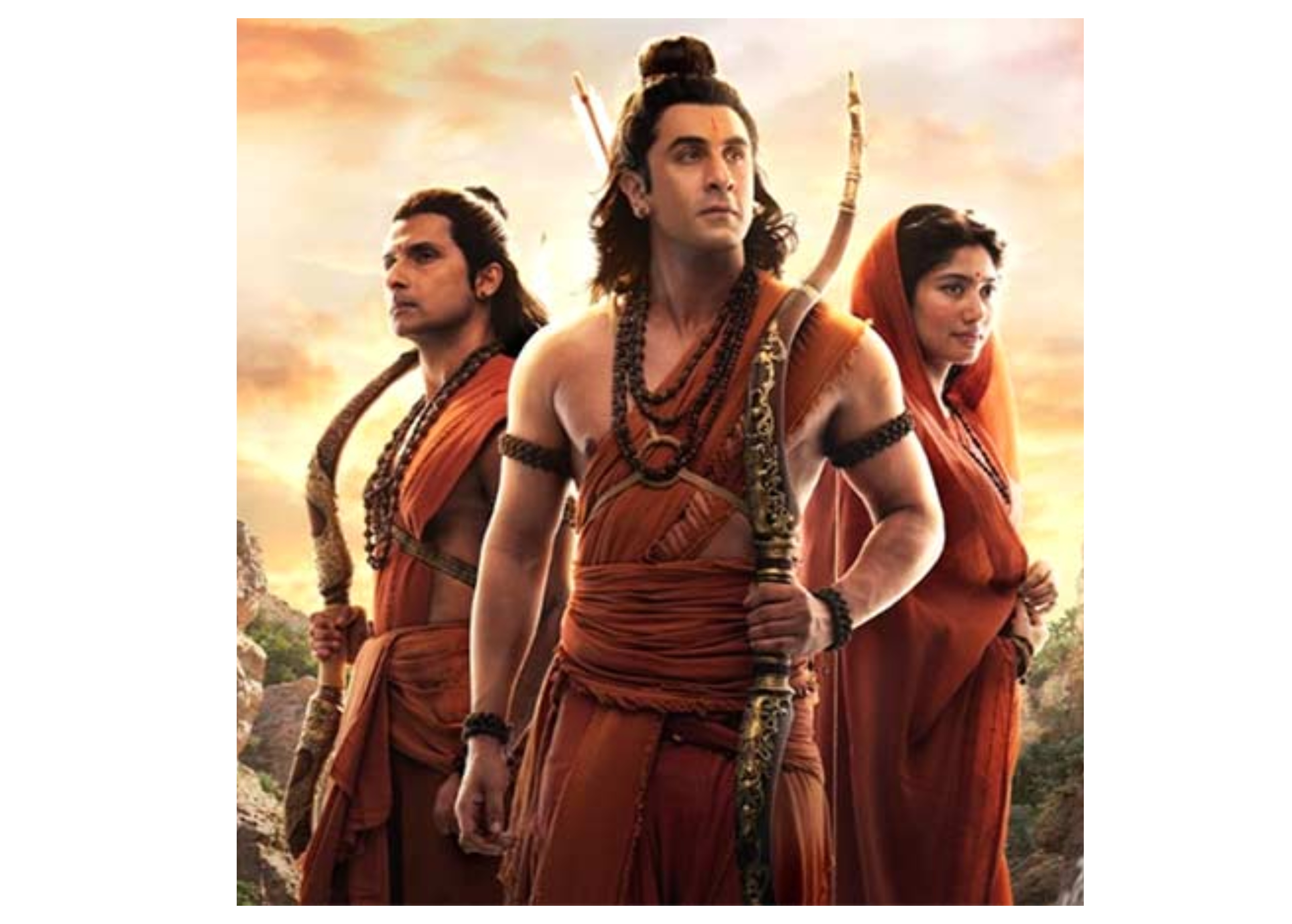
RAMAYANA (Part One) : MOVIE REVIEW
RATING : 4 STARS / 5 (EXCELLENT)
DIRECTOR : NITESH TIWARI
CAST : SAI PALLAVI, RANBIR KAPOOR
YASH, RAVI DUBEY
HINDI, WITH MULTIPLE DUBBED LANGUAGES
ENGLISH SUBTITLES AVAILABLE, 2026
Stupendously expensive and magnificently mounted to match any Hollywood extravaganza, 'Ramayana : Part One" (2026) is at long last the movie that does justice to the great Indian mythological epic. Producer Namit Malhotra and director Nitesh Tiwari hit the ball out of the park with a lavishly constructed opus that nails both the dramatics and a plethora of world-class special effects. A god-like prince is exiled to the forest on the cusp of becoming king, his wife is then abducted by a mega-villain who makes Thanos look weak, and then all hell, hinterland and Lanka breaks loose as the big boys set out to take back their lost chestnuts. Director Tiwari is already the glorious helmer of the outstanding 'Dangal' which amassed Rs.2000 crore to become the highest earning Indian film worldwide. While Ramayana 1 & 2 have a combined budget of a jaw-dropping Rs.4000 crore (USD 423 million), opening day indicators suggest the stars aligning to mint another astronomical record.
India is home to 1.4 billion people and there are very few other epics if any at all whose fabled story is so well-known by so many. The 1987 TV serial by Ramanand Sagar was monumentally popular, but Indian cinema just couldn't produce a film of equivalent stature. 'Adipurush' (2023) lacked fire and could not even gross Rs.400 crore against a towering budget of Rs. 700 crore. But this film-making team is able to accurately place its finger on the pulse of both the basics and the hijinks.
God-like prince Rama has the rouge-lashed gateau and motichur laddu laid out for him in his kingdom of Ayodhya. He does what no man can do and wins the hand of sweet to-be-wife Sita. But the wages (with interest) of polygamy come home to roost for Rama's father King Dashratha. The aging king is done in by the demand of one of his wives who in turn is played like a fiddle by her scheming old maid. Exiled fourteen years to the forest, joined by his devoted wife Sita and his altruistic half-brother Lakshmana, the trio have to contend with the treacherous jungle's teeming fauna which range from marauding ogres to frustrated demonesses to much worse.
I was misled by INOX, Jayanagar, Bangalore who sold me the tickets for the Kannada dubbed version (without verbally telling me that it is in Kannada and not Hindi) when I went to buy tickets three days before the first show. The usual Hindi version's next show was three hours after my booked show. As my companion did not want to return for that, and as I understand Kannada, I reluctantly sat down to watch the movie. Some solace - I haven't heard a caliber of Kannada better than the one in the movie. The Kannada spoken in this dubbed version is so formal, elegant and heavily Sanskrit-centric that in memory it almost sounds like Hindi ! When Sita and Lakshmana are in disagreement over whether a cry for help actually came from Rama or an impostor, the word "Dosha" is used. "Dosh" in Hindi means the same thing - blame.
Tiwari's biggest achievement lies in ensuring a grand and powerful level of special effects and action choreography. The dramatics are important of course but that emotional terrain has already been covered in the 1980s' fine TV serials. But India has not had a Ramayana or Mahabharata with rip-roaring special effects and that is what Tiwari delivers in spades. The early sequence where Ravana, after getting a boon of invincibility from God, goes on the rampage in a palace fort and manhandles an army of soldiers like throwing toys around, is handled in smooth-'n'-mighty fashion. The intro shots of both Ravana (Yash) and Rama (Ranbir) have the right gravitas but Yash's supreme emergence as the rampaging Ravana packs more clap-worthy wallop for his fans. From there, the story of Dashratha (nice touch bringing back Arun Govil whose face is imprinted on generations as the noble Rama from 80s' TV), Rama and Sita is consummately covered till the forest exile signals the movie's interval.
The one superfluous sequence which is not in sync with Ramayana's redolence, is the one where Rama, Sita and Lakshmana have to battle an army of ogres and demons. A lot of people would be surprised to see Sita as a swashbuckling warrior who would make Neo from Matrix blush. Tiwari and co-scriptwriter Shridhar Raghavan who otherwise do a fine job, have to be careful about not making Ramayana mindlessly morph into a Lord Of The Rings battle sequence.
Such gratuitous action sequences would not have found space in an all-inclusive single Ramayana movie. But the lure of doubled profits has made this team split the epic into part one and two, thereby sacrificing the challenge of crafting a single supreme movie.
Unexpected emotional depths are disclosed when the action choreography leaves some breathing space. When Sita's family member lashes out with a sword in anger, it is Sita who is the voice of reason and compassion, instructing the attacker that he does not have the right to disfigure a woman's body, and that persuasive skills should instead have been deployed.
The best special effects and action sequence is reserved for the end. The fantastic lotus-shaped aerial vehicle that Ravana uses to abduct Sita looks much more convincing in the 3D movie than in the TV trailers. There's a terrific shot which zooms in from outside, past the craft's rotating mechanism, and swoops into the large lower deck where Sita stands hostage - this shot very likely plays out much better in 3D than without. Jatayu - The King Of Vultures - and an old friend of Rama's father, launches a thundering attack on this craft, knocking the daylights out of Ravana. But Ravana being his supreme demonic self, survives and lashes back more and more at Jatayu. This one to one fight in the skies is superbly pictured, and Jatayu's eventual predicament at the hands of a relentless demon king is strikingly poignant. The giant vulture king is excellently delineated in its awesome features - a better Jatayu has never been seen.
The film boasts another unique feat - bringing together two musical kings from the east and west - A.R. Rahman and Hans Zimmer. Producer Namit Malhotra seems to have spared no expense or grandiose star collaborations in making his vision bear fruit. Zimmer towers in Hollywood, and Rahman after bewitching India and the world for decades seems to be now suffering the fate of Jatayu, after falling from the skies. The background score is grand and subtly melodic, reaching its zenith in the sequence where Rama leaves Ayodhya - crescendoing with Rahman's own poignant aria. However, the background score as a whole does not have the sparkle that Rahman's or Zimmer's best work has. Rahman has already delivered sublime background scores and songs for Ratnam's 'Raavan', which despite its major flaws, was a virtuosic modern flip of Ramayana. There are hardly any songs in the movie which is a bit of a shame considering that the Rahman of the 90s and 2000s would have made Lord Rama weep upon listening to the music. One hopes part two will feature a more memorable background score from this titanic duo.
I saw the film in 3D (the theatre had no other version) and thankfully did not regret it later. Tiwari & team, however, do not smash the 3D ball out of the park but neither do they injure the pictoral scheme with misguided use of 3D (the latter mistake happened in Avatar 2). As I saw the film in 3D, I cannot fully comment on Pankaj Mishra's and Mahesh Limaye's cinematographic style. To nitpick, flamboyance and a special eye are not exactly in abundance here, but it cannot be denied that they have done solid work in covering a complex and demanding visual framework.
The film's best acting belongs neither to the hero nor the heroine nor the villain, but to Ravi Dubey who adroitly essays Lakshmana, Rama's devoted half-brother. His noble visage can just as easily have a flicker of naughtiness flitting past it, even as the temperature of his temperament can ratchet up with quick anger. A cold-eyed hard-jawed resolve can set into him as he senses the subterfuge of villains that fatefully foxes his seniors. It would not have been easy for Sai Pallavi to get Sita's role, as competitors like Rashmika Mandanna could well have garnered the prize. But not for nothing does Sai Pallavi have one of the most radiant countenances in the entire pantheon of Indian film heroines. She makes Sita her own with her trademark sparkling expressions and tender vulnerability.
Yash's Ravana is competent, if unspectacular. The steel is predictably there, but the supple charisma needed for a great Ravana is unsurprisingly in short supply. This on-paper role has terrific potential for colorful villainy but Yash instead of cracking a fluid whip, sports the stiffness of a bludgeon. Amazingly, he gets company and temporary kinsmanship from no less than Ranbir Kapoor's Rama. Ranbir has nobleness stamped on his face from start to finish, with hardly any dynamism to animate and flesh out the personality, as if he fears that if the nobleness leaves his face even for a second, the resultant void might destroy Rama forever.
Enthiran (2010) and Bahubali I & II (2015 - 2017) blasted open the door for world-class VFX for Indian cinema. And now Ramayana has taken forward this high-wire game, ensuring high standards for great special effects, while wedding this template to quality drama. Every mis-step that 'Adipurush' stumbled into, Ramayana rectifies and elevates. Malhotra and Tiwari have taken a giant step forward for Indian cinema, and regardless of how part two works out, their work silently exhorts other Indian film-makers to break the boundaries of blockbuster film-making.
UPN
UPNWORLD welcomes your comments.



0 COMMENTS
WRITE COMMENT