
WUTHERING HEIGHTS
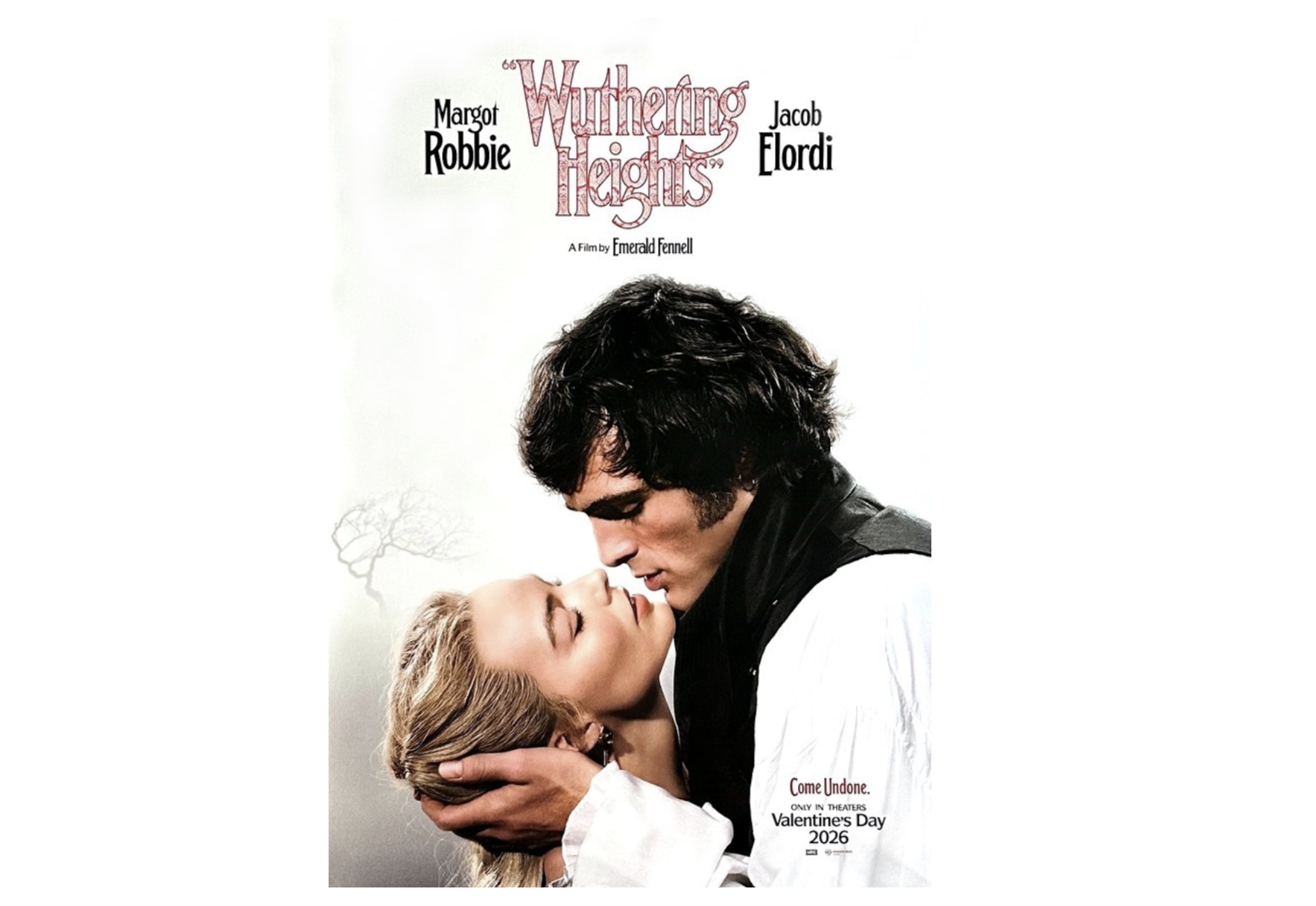
WUTHERING HEIGHTS : MOVIE REVIEW
RATING : 4 STARS / 5 (EXCELLENT)
DIRECTOR-WRITER : EMERALD FENNELL
ORIGINAL NOVEL : EMILY BRONTE
CAST : MARGOT ROBBIE, JACOB ELORDI
SHAZAD LATIF, HONG CHAU
ENGLISH, FEB. 2026
Planning to watch "Wuthering Heights" on Valentine's Day ? You both will go home brooding instead of smooching, trying to lay your finger into the viscous eddies and miasmic haze of the wild romantic currents that swirl here. Director-Writer Emerald Fenell brilliantly adapts Emily Bronte's searing 1847 novel into a deliriously charged movie lashed by panting moor mists, drowning in dark festering interiors of hill-top cave-homes, and ecstatically luxuriating in grand surrealist environs of Gatsby-esque mansions.
The source novel "Wuthering Heights" ("Wuthering Heights is the name of Mr Heathcliff's dwelling, 'wuthering' being a significant provincial adjective, descriptive of the atmospheric tumult to which its station is exposed in stormy weather", the novel tells us) was written by Emily Bronte to little acclaim in 1847 and the young author died just a year later at age thirty, never knowing the immense popularity her work would accrue in succeeding centuries, besides engendering no less than seventeen movie adaptations. The novel is structurally longer than the movie and spans multiple generations and characters. I read it ages ago but still remember Bronte's exquisitely elegant narration and the throes of Heathcliff's intense suffering and anger caused by love-failure amongst other ravages of life. Fennell's adaptation simplifies and distills the family tree to the travails of just one generation and a few characters. The two main characters are Heathcliff and Catherine, the story set in the upland estates of West Yorkshire moors - rolling hills, mist et al.
Heathcliff is adopted and brought into Catherine's household and they grow up together. The household is moneyed, estate and all, but Heathcliff is given the 'orphan' rough treatment and grows up fostering the wounds of this hostility. Catherine though is nice to him and and as young adults they fall in love, even as Catherine has reservations about his uncertain social status. She gets drawn to a rich young man Edgar Linton in the nearby estate Thrushcross Grange and eventually marries him. Heathcliff leaves the scene and returns later as a wealthy man himself, rekindling the flame with Catherine even as she's far gone into her marriage with Edgar. In the novel, things are fairly coy as H & C never make the beast with two backs, but Fennell being Fennell, here in the movie the vitals are shoved in and the sarong is banished in poetic orgies of wild abandon.
The film's foremost asset is Fennell's lyrical directorial flow for much of the film. What sets apart a good director is how they understand and execute the whole syncytium - not only the shot-taking with its smooth composition but also stitching together a succession of scenes for one to three hours, never forgetting the emotional undertug, with good image selection, with or without the bonus of artful background music which ties everything together. Sometimes you don't need the sauce, just the meat is enough but Fennell packs it all in, secure in the template of Bronte's source material being narrative gold. She nails both the terrain and indoors, blends it all in her enchantress' cauldron, and kick-tosses it from the moors to the clouds.
She facilitates easy chemistry between Robbie's young flowery Emma and Elordi's rugged handsome Heathcliff which handily carries the movie on its shoulders before the big rupture. On Heathcliff's sophisticated return, there is a frisson, with his cool rakish flirting and Edgar's sister Isabella's sauciness contributing to the salacious milieu, before all panties break loose. For three-quarters of the movie, there are smooth finessed larks abetted by distinct visuals and powerful music. Especially in the first half, there is a bruising honesty to the characters - after Emma spends six weeks in the aristocratic luxury of Thrushcross Grange and returns to shabby-Gothic Wuthering Heights, Heathcliff instinctively realizes she has gone away further - she calls to him in good cheer but from the middle of hard estate labour, he looks up and tells her he does not have time to fool around. She has had a bigger taste of the English good life now, from shepherd's pie to frosted cake and he may not be able to offer her much of the latter.
But that emotional honesty goes missing in the movie's last act and the film loses a lot of emotional capital due to this auto-pilot crash. 'Wuthering Heights' in the novel is a spanking good love story especially in the first half, but for those who want a little more bacon to chew on, it could well be seen as an allegory of how Britain's class systems and its classy boot-lickers devour themselves alive (whether it's the crumbling environs of Buckingham Palace for Princess Margaret in 'The Crown' season 1 or here in the god-forsaken moors where nothing grows except love-failure), shot through with rich shades of a woman's selfishness in leaving two men after the initial pretense of love. The movie is so good for the most part that Gustave Flaubert would have turned over in his grave, only to go back to eternal sleep after realizing that Fennell's Catherine does not have much of the exquisite psychological delineation that he lavishes on his Emma of 'Madame Bovary'.
Catherine may argue that she was right in leaving behind the younger Heathcliff as a life partner even though she loved him, because social standing and sophistication also matter. The moneyed man she then marries - Edgar Linton (Shazad Latif) - is a decent if shockingly bland chap who is shown to treat her well, and when the newly wealthy Healthcliff returns, Catherine falls for him like a lump down the hillside. She has the nerve to ask him why he left her, and he has the sense to coolly tell her she betrayed herself. A certain kind of callisthenics then ensues - the furtive shenanigans and panting return of new lovers who can't get enough of each other. The issue here is that the rapier thrust into Edgar's marriage does not make for great audience pull especially as he himself is a decent bloke. An attendant (smoothly played by Hong Chau) plays the tough guard of the fort, burning letters and scuppering communication but in the pic's last leg, the emotional meat that earlier rippled through is now a gnawed-through bone that is too weak to support the film's weight. I was looking at the watch more than once. Full blown love-failure now finally sets in but because the narrative intricacies are not intelligently plotted, no genuine pathos is created despite all three characters plunging into devastation. Well constructed, carefully designed love-failure movies deliver a gut-punch at the end - you really feel for the characters' loss, so much so that you dream up alternative happily-ever-after scenarios for them. Here the plotting in the crucial last leg is so mechanical and bereft of emotional nuance that it is difficult to feel sadness for the thwarted lovers.
The trope of a lady, presently married to a moneyed crashing bore, developing the hots again for her former flame who returns, not because the latter is his good ol' penniless self but because he's now loaded with lucre or at least the appearance of it, unsurprisingly finds wide currency in popular works over centuries. It swings, dies and erects this way not just in 1847 to 2026's Wuthering Heights, but also in the genius Kind Hearts And Coronets (1955), and this cynical but often real-life bosom-heaving-only-for-money theme also pulses across the Atlantic to imbrue and devastate even The Great Gatsby.
Nonetheless, Fennell is nascently turning out to be this generation's darkly grinning mischief-maker who doffs her hat to last century's Luis Bunuel. She returns with her recent oeuvre's striking eccentricities and trademark perversions. In 'Saltburn', the fooling around with effluvia took the revolting cake along with shameless acts of pleasuring oneself. Here, she makes egg yolks serve a similar purpose, in addition to Catherine sticking her finger inside a casing of aspic to enter the mouth of the fish inside. Earlier, Bronte would have blushed crimson on seeing her Catherine pleasuring herself behind a boulder while Heathcliff slowly arrives from the side in gentle passive encouragement. Fennell then slings her grotesqueries as Isabella behaves like a rabid dog in Heathcliff's home. She cocks a snook at marriage - as Heathcliff and Isabella go to the marriage registry, a lady runs away crying down the walkway. The priest administering the oath couldn't be bothered with the entire recitation, telling the couple "Now, you may kiss, etcetera". The baroque green and gold bed of Edgar and Catherine is shown only after it is past its purpose.
So it's a memorable love-story film but Fennell's subversive streak looms large at the end, burying any mellow feelings. I wouldn't be surprised if 'The Nightcomers' (1971) is one of her fave unlisted films.
Anthony Willis' lush dysphorically swirling soundtrack and Charli XCX's soaring songs often boost the narrative. The strong orchestral underlines, sometimes tweaked discordantly, have such a classic-contemporary flair that I wondered at first whether it was Jonny Greenwood.
Fennell brings back Linus Sandgren for the cinematography and she prefers a visual scheme not very different from 'Saltburn' - not too bright on the lighting, with proper colour saturation, a little granular and soft in the resolution, like a colour print from the 1960s. But there's no doubt that the misty English moors, dark spaces of the Gothic eponymous estate and eye-popping colour schemes of Thrushcross Grange are cleanly captured.
The set design is another matter. A huge glossy red floor contrasted with white walls and ceiling, recalling the grandly surreal room set-up of another Brit Anish Kapoor who shocks a large white room with a red mountainous heap of vermillion powder, will go down as one of the iconic images of this film. Thrushcross Grange where Emma spends her later life abounds with the baroque and colourful. Wuthering Heights' main gathering room which memorably stars at the start of the novel, has its ceiling covered in an exposed thick lattice of blonde wood, like a whale-rib exposed to show the inner ugliness. There's a single rib vault of a huge stone arch outside on the grounds where the two principals as children take refuge from the rain, where a hung pig is cut open with the ground beneath flowing crimson, and later where the two adults make love and prepare for their hearts to be slashed again.
Before the adults enter the scene, the child actress Charlotte Mellington impresses with her sparkling facial expressions and alacritous acting. Pic would have benefitted from at least some salt and pepper in Shazad Latif's innocuous rendition of Edgar Linton, although it is commendable on part of Fennell to cast this actor of part-Asian ancestry as a frontline character in a classic English tentpole movie. Tall, muscled-boned-and-solidly-
UPN
UPNWORLD welcomes your comments.


0 COMMENTS
WRITE COMMENT